MACHINE VISION · WEB MATERIALS
How to Validate Machine Vision Across Nonwoven and Web-Material Production
Principle & workflow
From production motion to quality evidence
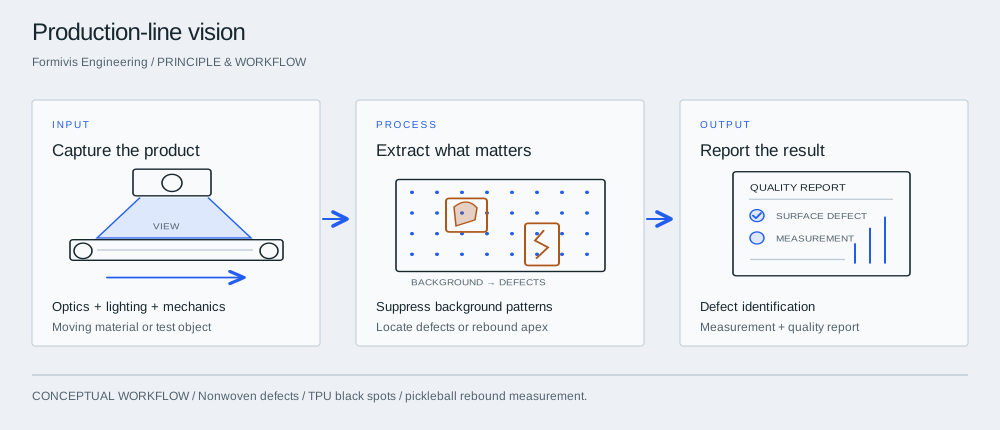

InputCapture the product
The optical and mechanical setup is designed around the material and production process. A high-speed camera can also observe a pickleball drop and rebound.
ProcessExtract what matters
For nonwoven fabric, suppress background dot patterns to expose insects, stains or tears. The TPU case identifies black spots; the pickleball case measures the rebound apex.
OutputReport the result
Provide application-specific inspection results. In the rebound-height case, the profile describes an automatically generated quality report for each ball.
Define the defect decision before choosing a metric
A production team should begin with the defects that create an actual quality decision: holes, contamination, folds, texture changes, coating anomalies or another clearly defined class. Separate defects that require line stoppage from those that only need traceability or later review. This prevents a pilot from optimizing a generic classification metric that does not match operations. The defect taxonomy should also define ambiguous examples and acceptable variation, because disagreements in labeling can dominate the apparent performance of a model even when the imaging system is stable.
Treat material and optical conditions as part of the test
Nonwoven and continuous web products can change appearance with basis weight, fiber orientation, gloss, embossing, coating, tension and illumination. A system that performs well on one roll under one lighting setup may not transfer to another material family. Build the evaluation matrix around representative production lots, line speeds, widths and lighting conditions. Record camera geometry and exposure settings. NIST’s 2026 smart-manufacturing AI roadmap emphasizes the integration challenge created by heterogeneous sensing, industrial data and the need for trustworthy operation; the same principle applies to an inspection pilot.
Report missed defects and false alarms by class
An average score can hide the operational tradeoff. Report missed defects and false alarms separately for each defect class and operating condition. For rare but high-consequence defects, include enough real or controlled examples to understand uncertainty instead of extrapolating from a handful of images. Review where the system has no usable decision, such as motion blur, contamination on optics or a material condition outside the training/evaluation set. If operators must confirm alarms, measure that workload as part of the system rather than treating human review as free.
Test traceability and line integration
Inspection becomes useful when findings can be connected to production. A pilot should define how detections are time- or position-referenced, how images are retained, what event data is sent to PLC/MES/quality systems, and how an operator can retrieve evidence later. Integration errors can undermine a strong vision model. Test network interruptions, sensor synchronization and changes in line state where relevant. These checks also make it easier to separate a perception issue from an integration issue during acceptance.
Expand material scope through evidence, not assumption
After the first material and defect classes are accepted, add the next material family as a new evaluation set. Do not assume a model validated on nonwoven fabric automatically transfers to film, paper, coatings or another web process. Formivis reports production-line vision cases and source-specific performance figures in its technical profile. Those figures should stay attached to the reported cases. New materials should receive their own sample review, defect taxonomy and acceptance protocol before performance is generalized.
Define denominators before presenting a detection score
For a proposed roll trial, record material lot, inspected length or area, line state, defect class and the reference-label method. Report how many labeled defects were available in each class, how many were missed and the false alarms per agreed unit of inspected material. Keep repeated views of the same physical defect from inflating the sample count. Set aside complete rolls or production lots for final evaluation rather than scattering adjacent frames from one roll across development and evaluation sets. These are proposed acceptance controls, not reported Formivis test results.
Take into the discussion
- Defect taxonomy tied to quality decisions
- Representative lots and line conditions
- Per-class missed-defect and false-alarm results
- Traceability and integration checks
- Material-by-material expansion plan