FEA · THERMAL-STRUCTURAL
How to Scope Thermal-Structural FEA Before Prototype Testing
Principle & workflow
From physical assumptions to a design decision
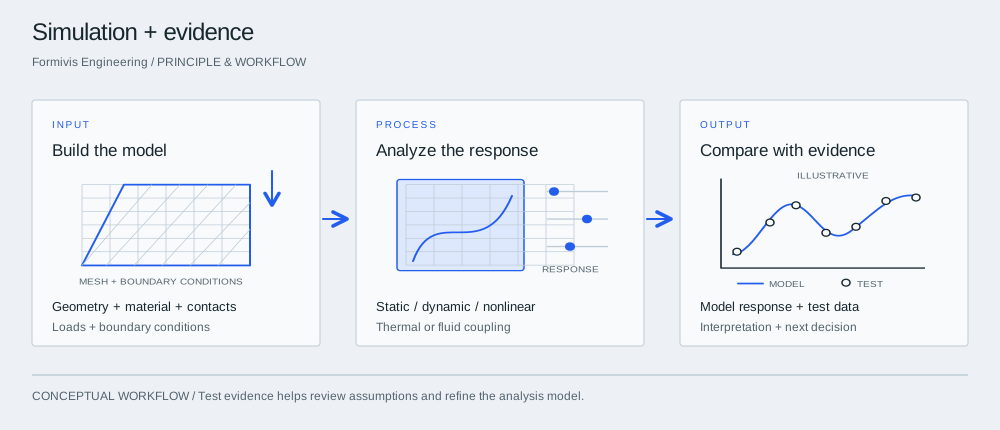

InputBuild the model
Define the physical question and the inputs that control it. Build a model with traceable units, material properties, contacts and constraints.
ProcessAnalyze the response
Choose the analysis that matches the question: structural response, fatigue, crack growth, creep, thermal stress or fluid–structure interaction.
OutputCompare with evidence
Compare modeled quantities with available physical measurements, review sensitivity and explain what the results mean for a design change or validation plan.
Start with the decision and coupled physics
Thermal-structural analysis can answer very different questions: whether thermal expansion creates an alignment problem, whether a temperature gradient changes preload, whether a housing deforms beyond a tolerance, or where a prototype should be instrumented. Write the decision first and identify which physical coupling matters. A detailed model that does not correspond to the decision can consume time without improving confidence. Define which outputs will drive the decision and what magnitude of model uncertainty would materially change the conclusion.
Record boundary conditions and material data as evidence
Heat inputs, convection assumptions, contact conductance, constraints, preload and temperature-dependent material properties can dominate the result. Record which inputs are measured, specified by a supplier, estimated or fitted from earlier tests. If a property is uncertain, use a range rather than a single convenient value. This creates a direct path to sensitivity analysis and tells the prototype team which measurements would most reduce uncertainty. The model should also document units and reference temperatures because small inconsistencies can create misleading conclusions.
Use sensitivity and verification before correlation
Mesh refinement, time step, solver settings and contact definitions should be checked before comparing a model with a test. NIST has described finite-element simulation as a virtual experiment in which modeling, discretization and computational uncertainty need explicit treatment. The practical implication is that correlation should not be used to compensate for an unstable numerical model. First determine that the relevant outputs are reasonably insensitive to numerical choices; then investigate uncertainty in the physical assumptions.
Design the prototype test to answer the model question
Select thermocouples, displacement measurements, strain gauges or other instrumentation based on the decision and sensitivity analysis rather than adding sensors uniformly. The test plan should include environmental conditions, load sequence, stabilization criteria and measurement uncertainty. If the model predicts a local effect that cannot be measured, identify a proxy or adjust the question. The goal is not to make every contour match. It is to gather enough independent evidence to decide whether the model is useful for the engineering choice.
Treat correlation as model updating, not certification
Differences between simulation and test should lead to a structured review of assumptions, material data, contacts and measurement uncertainty. A correlated prototype does not automatically certify another geometry or operating range. Formivis describes structural, failure and multiphysics simulation together with machining and physical test resources in its technical profile. A project should define which parts of that chain are in scope and what additional qualification or certification, if any, remains outside the study.
Keep calibration and confirmation runs separate
Before a thermal cycle, define a run sheet containing the temperature history, mechanical restraint, preload, sensor positions, sampling settings and acceptance quantities. Use an agreed subset of measurements to update uncertain inputs, then reserve a separate condition or repeat run to check the updated model. Do not present the same measurements used to fit a contact or convection parameter as wholly independent confirmation. Record which conclusions remain valid only within the tested temperature and restraint range.
Take into the discussion
- Engineering decision and coupled physics
- Traceable thermal and mechanical inputs
- Mesh and solver sensitivity checks
- Instrumentation tied to uncertain assumptions
- Correlation and model-update plan