MANUFACTURING QUALITY
Production-line vision: nonwoven, TPU and pickleball cases
Principle & workflow
From production motion to quality evidence
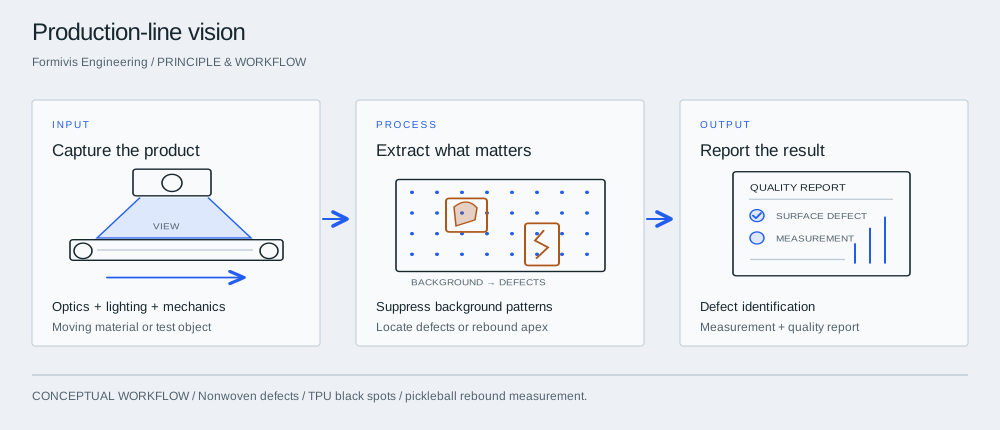

InputCapture the product
The optical and mechanical setup is designed around the material and production process. A high-speed camera can also observe a pickleball drop and rebound.
ProcessExtract what matters
For nonwoven fabric, suppress background dot patterns to expose insects, stains or tears. The TPU case identifies black spots; the pickleball case measures the rebound apex.
OutputReport the result
Provide application-specific inspection results. In the rebound-height case, the profile describes an automatically generated quality report for each ball.
Remove the background pattern
A proprietary algorithm suppresses the dot-pattern background of nonwoven material so insects, oil stains and tears can be distinguished from the substrate.
Match the production process
Develop optics and mechanical mounting together with algorithms and the software interface, so the system fits the line’s pace and installation conditions.
Measure behavior as well as appearance
High-speed imaging extends inspection from visible blemishes to rebound-height measurement and individual quality reports.
Reported figures and their scope
Inspection speed, up to: 15 m/s. Reported for the nonwoven production-line inspection case. Minimum detectable defect area: 0.25 mm². An area threshold in the nonwoven case, not a 0.25 mm linear resolution. Missed-defect rate: <0.1%. Reported for the nonwoven case; the profile does not disclose the full test sample or denominator. Production-quality applications: 3 cases. Nonwoven defects, TPU tyre black spots and pickleball rebound height.
Nonwoven fabric defect inspection
The profile reports production-line validation at up to 15 m/s with a 0.25 mm² minimum defect area and <0.1% missed defects. Width, contrast and defect-class acceptance belong in the line-specific scope.
TPU tyre black-spot inspection
An online real-time system identifies black-spot defects on a TPU tyre production line. The profile provides no transferable defect-size or speed figure for this case.
Pickleball rebound-height QC
A high-speed camera follows a fixed-height drop, identifies the rebound apex and generates a quality report for each ball. Measurement tolerance is agreed during system scoping.
Project interpretation
The three numerical detection figures belong to the nonwoven case. They should not be transferred to TPU, pickleballs or another material without a representative sample and line evaluation.
Take into the discussion
- Defect classes and representative material samples
- Line speed, width, lighting and installation constraints
- Acceptance criteria for missed defects and false alarms
Technical questions
What performance does the nonwoven case report?
The technical profile reports inspection speed up to 15 m/s, minimum detectable defect area 0.25 mm² and missed-defect rate <0.1%. These are case-specific figures; line width, sample composition and the complete test protocol are not provided.
Does the system only inspect fabric?
No. The profile also describes real-time TPU tyre black-spot inspection and automated pickleball rebound-height measurement with a quality report for each ball.
What does the reported novelty assessment establish?
The profile references a novelty-search assessment. It should not be represented as an international product certification or as an independent validation of every performance figure.