Five-axis machining centers
Listed platform inventory for precision metal machining.
BUILD & TEST University-supported laboratory platform
Prototype machining and static, dynamic and extreme-environment testing through a university-supported laboratory platform, including two five-axis machining centers, 1000 kN materials testing and a listed −80 to 1600°C component chamber.
Plan a validation program ↗Technical highlights
Reported capabilities and figures from the supplied technical profile, with their application context.
Listed platform inventory for precision metal machining.
Tension, compression, bending and shear; extended stroke accommodates environmental testing.
Listed for the component static-environment chamber; not the range of every test system.
Listed equipment range for dynamic impact loading.
Source: Technical Capabilities — External Presentation · 2026-08 · pp. 9, 10. Source and scope ↓
Engineering overview
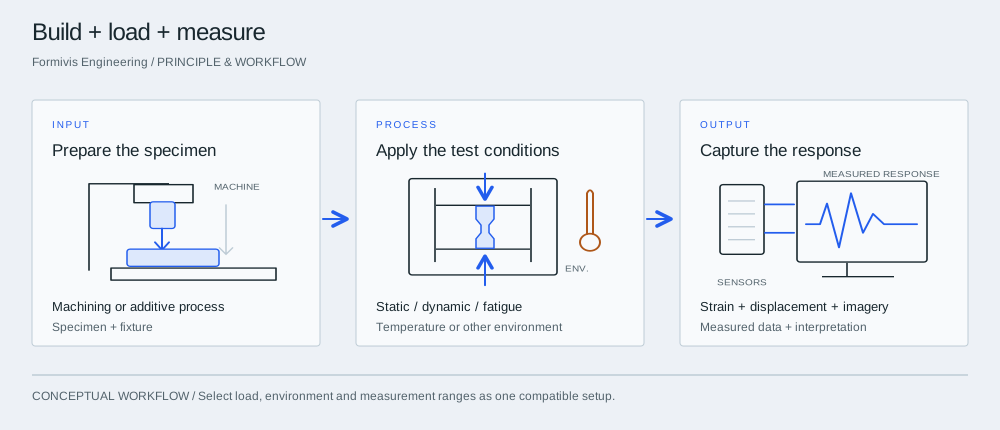
Four connected platforms support a route from analysis to a machined specimen and measured response: computational analysis, machining, static/dynamic mechanical testing, and extreme-environment equipment with signal acquisition. The source describes access through a university laboratory platform.
Principle & workflow

Connect the drawing, material and specimen geometry to the machining route. Prepare the fixture and measurement locations as part of the test plan.
Choose a compatible combination of loading and environmental equipment. Individual maximum ratings do not mean all maximum conditions can be applied together.
Use appropriate optical or bonded strain measurement, laser displacement, vibration signals or high-speed imagery to characterize the response and compare it with the target.
Machining
Combine five-axis machining, sheet-metal bending, industrial 3D printing and wire EDM with the specimen and fixture requirements of the test plan.
Mechanical testing
Connect materials testing, fatigue, vibration, creep and dynamic mechanical analysis to the load cases used in design and simulation.
Environment & acquisition
Pair environmental equipment with optical or bonded strain measurement, laser displacement and high-speed imaging as appropriate for the specific test configuration.
| Equipment | Quantity | Application |
|---|---|---|
| Five-axis machining center | 2 | Precision metal machining |
| Stainless-steel bending machine | 2 | Sheet-metal forming |
| Industrial 3D printer | 1 | Additive manufacturing |
| Wire EDM | 1 | Precision cutting |
| Bench drill | 2 | Drilling |
| CNC tapping machine | 1 | Thread production |
| CNC machine tool | 1 | General machining; type not specified |
| CNC milling machine | 1 | Milling |
| Welder | 1 | Welding |
| Grinder | 2 | Grinding |
| Equipment | Listed rating / capability | Engineering use |
|---|---|---|
| Universal materials tester | 1000 kN | Tension, compression, bending and shear |
| Impact tester | 150–300 J | Dynamic impact loading |
| R10 light-gas gun | 50–600 m/s | High-speed material and structural impact characterization |
| R50 light-gas gun | 0–50 m/s | High-momentum structural impact characterization |
| Vibration table | 18-tonne rating; 1–5000 Hz | Vibration simulation; the source does not define the 18-tonne force/load convention |
| Small/mid seismic and vehicle vibration tables | Multidirectional and coupled vibration | Structural foundations and vehicle uneven-road response |
| Split Hopkinson pressure bar | High-strain-rate characterization | Material constitutive and damage-response characterization |
| DMA analyzer | Static, dynamic and thermal parameters | Metals, composites and polymers under temperature conditions |
| Creep tester | Service-environment creep | Metals and composites |
| High-frequency environmental fatigue system | 0–20 kN / 0–50 kN; 0–10000 Hz | Tensile, bending and axial vibration testing; configuration-specific ranges |
| Vibration fatigue bench / dynamic tensile machine / MTS fatigue machine | 1 of each | Fatigue and dynamic mechanical testing |
Equipment limits are listed individually. Simultaneous load, frequency and temperature capability must be confirmed for the selected setup.
| Equipment | Source-listed scope |
|---|---|
| Component static-environment chamber | −80 to 1600°C; chamber notation “400×R50” |
| Structural static-environment chamber | Chamber notation “800×R400” |
| Extreme-environment fatigue chamber | Fatigue testing under environmental conditions |
| Humidity / salt-spray chamber | Corrosion-environment testing |
| Closed-loop high-speed impact loading equipment | Thermal-impact loading capability |
The chamber dimension notation is preserved from the source; units and the meaning of R require confirmation before specimen design.
| System | Measured information |
|---|---|
| Non-contact optical acquisition | High-temperature stress / strain |
| High-temperature bonded strain system | Bonded strain signals |
| High-speed strain sensor system | Strain and acceleration under demanding dynamic conditions |
| Laser displacement sensing | Vibration displacement |
| High-speed camera system | Impact imagery |
| Conventional vibration acquisition | Vibration, displacement, velocity and acceleration |
| Resource | Quantity in profile |
|---|---|
| Networked high-performance CAE workstations | 15 |
| GPU / graphics computing workstation | Quantity not specified |
| High-performance displays | 2 |
| Networking and parallel-computing components | 1 set |
| Abaqus, Ansys, Ansys Fluent, Ansys LS-DYNA, Zencrack, Optimus | 1 set each |
Applications & value
Application context
Machine specimens and fixtures, define measurement channels and compare measured response with the original engineering assumptions.
Application context
Study temperature-dependent response, fatigue or creep using an agreed specimen geometry and compatible equipment combination.
Application context
Evaluate structural vibration and fatigue for transport equipment, bearings, mining machinery and civil structures within the selected platform’s scope.
Who it's for
Product development and reliability teams needing a defined prototype and test program.
Bring the application, representative inputs and acceptance criteria. We will connect the relevant technology and platform to a defined engineering deliverable.
Before we begin
The profile lists two five-axis machining centers, two stainless-steel bending machines, one industrial 3D printer, one wire EDM, two bench drills, one CNC tapping machine, one CNC machine tool, one CNC mill, one welder and two grinders.
No. That range is attached to the component static-environment chamber. Temperature, load, frequency and specimen dimensions must be matched to a compatible test setup.
The source lists 18 tonnes but does not state the force/load convention. It must not be treated as a confirmed 18-tonne payload specification.
The next step